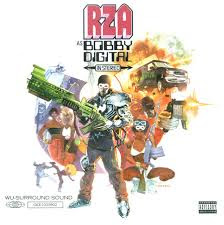
 I would like to challenge this commonly accepted discourse by making a case for the inclusion of RZA's very own solo debut "Bobby Digital: In Stereo" (1998) to be considered as a natural part of the aforementioned first round of albums that defined RZA as a producer and built the Wu-Tang brand. In that case it both marks the end of an era as well as the beginnings of a new one, something that can be said for "Wu-Tang Forever" as well. Coming two years after Ghostface's soulful celebration and embracement of his life, beats and rhymes, RZA went back to his well of inspiration to craft yet another totally individual chamber of sounds within the Wu-Tang pantheon. But this time the resulting body of work would take even the most loyal of followers by surprise as RZA stripped down the majority of what had made him number #1 to the hoards of people who worshippped at his altar - his mastery of creating music from samples. Although his various albums had contained very different styles they all shared the common thread of being sample based music. Around 1996 he had instead begun experimenting with a wide range of keyboards and synthesizers which he dubbed his "digitized orchestra" while also taking up Western music theory. Looking back at the album today and putting it within a wider context we can however see that this wasn't as sudden a transformation as was once believed the first time fans heard the synthesized "B.O.B.B.Y." blast through the speakers. I would say that the earliest precursor that could be considered Bobby Digital material would be the Hide-Out Remix of the Method Man single "The Riddler" (from 1995's Batman Forever soundtrack). Another joint that appeared months before the first single from "In Stereo" is called "And Justice For All..." which was featured on the Razor Sharp compilation "Wu-Tang Killa Beez: The Swarm". Naturally, a lot of the stuff we heard were already beginning to take shape on "Wu-Tang Forever" with its stripped use of samples in favor of digitized keyboards based on chord progressions and European music theory.
With this in mind it's clear that this "new" sound wasn't something that The RZA had haphazardly thrown together with the simple reason of doing away with sample-based music. This was a style that he had been working on and trying to perfect for quite some time, and someone with as good an ear as The Abbot has proven to master a style rather fast. What makes "In Stereo" so intriguing from a production standpoint is that it's still quite firmly rooted in the unpredictability and originality that came from RZA being a producer from starting out as a DJ (basing everything by ear), in contrast to a producer working slavishly from music theory (basing everything on "logic"). This unpredictability is something that RZA to a large degree lost as he became more immersed in Western musical theory, but on here he had yet not truly "got a grip on it" more than the most basic stuff, which allowed him to create a sound that mixed traditional and unexpected elements. Two great examples of this is "Unspoken Word" and "Mantis". On the latter cut he has the fat drums programmed, a repetitive piano loop, and really very little else, until he chooses to use what should, by all natural logic, be an incredibly annoying sound effect that sounds something like a repetitive control tone. This is used to create a kind of melody and is then looped across the entire track. With Bobby, Masta Killa and Tekitha all going hard as fuck the end result is hypnotic in its brilliance. The inclusion of . "Unspoken Word" similarily creates a hypnotic groove out of a fascinating anomali, created by a rock hard, but very short loop with a vocal sample that never gets to finish before it is looped back again. This keeps repeating for 5 minutes straight while RZA spits some of the hardest bars on the album - there's a lot of quotables on here and to me this would've been a better first single than the somewhat mediocre "B.O.B.B.Y.".
Like the preceding Wu-Tang albums he produced "In Stereo" is a very cohessive and thematically tight album. The musical tranks linked by accoustic piano intermissions of spoken words in different languages shouting out Bobby Digital as the worldwide superhero he is. As I mentioned above I was never crazy about the lead single "B.O.B.B.Y.", but from the second song and up to the last song on the thematic closer "Domestic Violence" "In Stereo" plays out like a modern day masterpiece. Similiar to the earlier albums mentioned above, the LP is filled with Wu-Tang Clan members (most generals make an apperance in one way or another - save for Raekwon) and like on the older albums some of the best tracks are the posse cuts and cuts with guests. Perhaps because RZA, though a good rhyme spitter, he's always best when surrounded by emcees of equally high caliber ("N.Y.C. Everything" with Method Man; the Inspectah Deck produced "Kiss Of A Black Widow" with ODB; the posse cuts "Holocaust", "Terrorist" and "Bobby Did It"). It also stands out as it is the first true Clan solo that heavily features what RZA in a The Source article in late '99 called his "C-artists" (Killarmy, Black Knights, North Star, Tekitha, Ms. Roxy, etc.). As such it was the first album that introduced the somewhat legendary Holocaust on a track where he attacked the song so viciously that he got the track (which was originally titled "Silkworm") named after him. Those two posse cuts with Ghost are also among the first two tracks to feature the style that Ghost would attract the whole world to with his "Supreme Clientele" style some 18 months later.
When discussing "In Stereo" as a classic it is important to note that the album features 21 tracks, with the information that the four final tracks are bonus RZA tracks (as in not made in Bobby Digital persona). As such the liner notes makes it clear that "Bobby Digital in Stereo" is finished when track #17 fades out - the excellent artistic and violent expression that is "Domestic Violence". Therefore it should be noted that when I am discussing "In Stereo" as a personal classic and a profound and cohessive musical statement on par with the first round of Wu-Tang solos, those sentiments are based on the front-to-back experience of listening to tracks 1 to 17. While a couple of the bonus tracks does have some merit (especially "Lab Drunk") it makes the album sound dragged out and the two weakest songs on the entire disc finish things off diminishes the artistic statement of the preceding cuts. To end the album on the one-two punch that is "My Lovin' is Digi" and "Domestic Violence" is nothing short of genius - the first one being a majestic string filled affair with beautiful, seductive female vocals and Bobby Digital declaring his love for women and love in general. On the other hand, "Domestic Violence" is the gritty backside of that same coin - where Bobby describes a fallen relationship in the harshest terms possible over a stripped down but gut punchingly hard beat. When the song fades out after over 5 minutes we've been treated to misogynistic rhymes and hateful attack on the former partners as well as a chaotic outro with U-God on the phone interrupting the fighting couple in a most cinematic way. When the song finally ends the sudden sound of silence is almost a relief, and like the moments after you've seen a great movie that had a profound impact on you, you'll sit there reflecting on Bobby Digital and his weird, intense world of hip-hop, drugs, women and violence.
Lastly, on an interesting side note, followers of this blog and Wu-Tang in general know that many artists releases different versions of albums for the Japanese market every now and then. Much like the Canadian release of "Supreme Clientele", the Japan release of "In Stereo" features a different tracklist which I have a hard time reconciling with the well-thought out concepts of the orignal album (or maybe the Japanese tracklist was the original before RZA realized there were more to be done - similiar to another pefectionist who kept shaping his work even after their original releases - Stanley Kubrick). The Japanese version loses all the skits and intros as well as the excellent "Handwriting On The Wall" featuring Ras Kass and RZA which uses the same drum-less "beat" as those interludes. Another song that doens't make the final cut is one of my favorites, the triumphant "My Lovin' is A Digi" which makes "Domestc Violence" so much more powerful. Instead the Japanese got the four RZA bonus tracks spread out across the album (yet the back cover still says that it DOES feature four bonus RZA tracks). But what makes the album really inteeresting for westerners despite being far from as good or cohessive - is the inclusion of the 11 minutes self-produced freestyle "Do You Hear The Bells" and the extended version of "Terrorist" with addiitional verses by Holocaust, Dom Pachino and Killa Sin. On the subject of "Terrorist" you have to admire how Bobby borrowed the bassline of "Wu-Tang Clan Ain't Nuthin' Ta Fuck With" and incorporated it in to the flavor of the digitized orchestra.
"Do You Hear The Bells" appeared on a free "N.Y.C. Everything" cardboard single with Stress Magazie that my homie Big Rob owned, so I got a high quality FLAC file here of that single for your enjoyment (it's quite large considering one of the songs is an 11 minutes/"freestyle"). And if you're intersted you can check out the original "Bobby Digtai In Stereo" (Japan) tracklist, rip the songs and put them in the proper sequence and see what you think. To my ears the US/European versions are far superior.
01. "B.O.B.B.Y."
02. "Unspoken Word"
03. "Airwaves"
04. "Love Jones"
05. "N.Y.C. Everything"
06. "Mantis"
07. "Holocaust" (Silkworm)"
08. "Terrorist"
09 "Bobby Did It ("Spanish Fly)
10. "Kiss OF A Blak Widow"
11. "Do You Hear The Bells" (9 Minute Freestyle)
12. "Project Talk"
13. "Lab Drunk"
14. "Fuck What You Think"
15. "Daily Routine"
16. "Donestic Violence"
"N.Y.C. EVERYGHING" / "DO YOU HEAR THE BELLS" (CDS) [FLAC]
01. "N.Y.C. Everything"
02. "Do You Hear The Bells" (Freestyle)


